
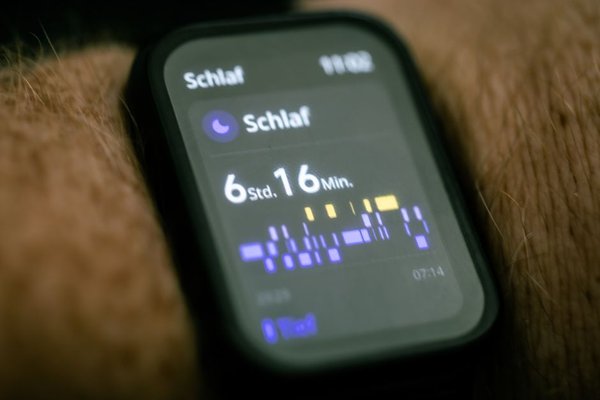
Your watch reports seven hours and 42 minutes of sleep, including exactly 68 minutes of deep sleep. It looks precise, but how much of that precision is real? Sleep tracker accuracy depends on what a device is estimating. Wearables can reveal useful patterns in your bedtime and sleep duration, yet their detailed sleep-stage charts deserve considerably more caution. The trick is knowing which numbers can guide everyday decisions and which are better treated as educated guesses.
What sleep trackers actually measure
A wearable sleep tracker does not usually observe sleep directly. Its motion sensors detect movement, while optical sensors often estimate pulse and changes in heart rate. Some devices also incorporate skin temperature, breathing-related signals or other measurements. Software combines these clues to estimate when you fell asleep, woke up and moved between sleep stages.
A clinical sleep study, called polysomnography, uses a different approach. It records brain activity, eye movements, muscle activity and other signals to identify sleep stages and investigate disorders. That is why a smartwatch’s polished graph is not equivalent to a laboratory recording. The watch is interpreting indirect signals, not reading your brain waves.
How accurate is the estimated time asleep?
For many people, total sleep time is among the more useful figures from consumer sleep devices, especially when viewed over several nights. But it remains an estimate, not a stopwatch measurement. If you lie quietly in bed, a device may interpret stillness as sleep. Brief awakenings can also go unnoticed.
A 2025 meta-analysis in the Journal of Clinical Sleep Medicine combined 24 studies involving 798 participants and found differences between wrist-worn devices and polysomnography in total sleep time, sleep efficiency and wakefulness after falling asleep. Average differences do not predict how wrong any particular person’s reading will be, and results vary by device and circumstances.
That distinction matters. A tracker showing six hours one night and eight hours the next may be highlighting a genuine change. A claim that you slept exactly seven hours and 42 minutes is much harder to justify.
Why sleep stages are the shaky part
Deep sleep, light sleep and REM sleep involve patterns of brain activity. Because most watches do not measure those patterns, their stage labels are algorithmic predictions. Sleep stages accuracy can vary substantially across models, software versions and individuals.
In a 2024 study comparing an Oura ring, a Fitbit and an Apple Watch with laboratory testing in 35 healthy adults, all three devices detected sleep periods with high sensitivity, but sleep-stage classification was less consistent. Another validation study of six wearables, published in 2025, found that devices generally recognised sleep better than wakefulness and achieved only fair-to-moderate overall agreement with laboratory scoring.
One night showing less deep sleep than usual does not prove that your brain missed a restorative stage. Nor does a larger REM slice guarantee better memory or emotional health. Such graphics are best interpreted as approximate patterns, not diagnoses or precise physiological measurements.
What about a nightly sleep score?
Sleep scores look convenient because they reduce an entire night to one number. But manufacturers calculate them differently, commonly blending estimated duration, continuity, timing and sometimes physiological signals.
It is also possible to feel refreshed after a low score or exhausted after a high one. Neither experience should be dismissed. Your daytime alertness, mood and ability to function are important pieces of information the algorithm cannot fully capture. If a score makes you anxious, consider hiding it while continuing to record bedtime and wake time.
A practical two-week test for your own tracker
Suppose your smartwatch sleep tracking repeatedly reports poor deep sleep on work nights. Before buying supplements or changing your routine, record a simple two-week sleep diary. Each morning, write down when you went to bed, approximately when you fell asleep, when you woke, whether you remember long awakenings and how rested you feel. Keep the watch settings consistent.
At the end, compare broad patterns rather than individual stage percentages. Perhaps your bedtime shifts by 90 minutes on weekends, and the shortest nights are followed by afternoon sleepiness. That is actionable information even if the reported deep-sleep minutes are inaccurate. You could try a steadier wake time and a realistic earlier bedtime, then see whether your daytime energy improves.
See our sleep diary guide and recommended sleep duration by age guide for context.
Getting useful data without chasing perfect numbers
Wear your device as its manufacturer recommends, keeping the fit comfortable and the sensors clean. Check that the sleep schedule and relevant settings are correct. Then give the data enough time to reveal a pattern. A week or two is generally more informative than one unusual night.
Focus first on recurring bedtime, wake time and approximate sleep duration. Cross-check suspicious readings against what actually happened: Did you watch a film motionless in bed? Did the battery die? Were you awake for an hour but barely moving? These everyday details explain why a tidy chart can be misleading.
Try not to treat changes in heart-rate-derived scores as proof that a particular food, workout or bedtime trick improved sleep architecture. Illness, stress, medication and sensor conditions may affect readings. Our explainer on sleep efficiency can clarify what that term means and why a consumer estimate should not be mistaken for a clinical measurement.
When a tracker is not enough
Persistent excessive daytime sleepiness, loud snoring with witnessed breathing pauses, gasping during sleep, chronic insomnia or symptoms that affect safety deserve a healthcare assessment, regardless of your app’s reassuring score. Conversely, a low score alone does not establish a sleep disorder.
The American Academy of Sleep Medicine advises that consumer tracking data cannot substitute for appropriate medical evaluation. Some devices offer specifically authorised screening or notification features, but a notification is not the same as a definitive diagnosis. Share patterns and symptoms with a clinician rather than using a wearable to rule conditions in or out.
Frequently asked questions
Are smartwatches accurate at detecting sleep?
They can estimate when you are asleep reasonably well, but quiet wakefulness and short awakenings are common challenges. Accuracy differs among devices and users.
Can I trust my REM and deep-sleep numbers?
Treat them as rough estimates. Wearables generally infer stages from movement and cardiovascular signals, whereas laboratory staging relies heavily on brain and other physiological recordings.
Why does my sleep tracker disagree with how I feel?
Algorithms cannot capture every aspect of restfulness. Stress, fragmented sleep, illness and errors in sensing can all contribute. Your experience matters alongside the numbers.
Should I stop wearing a tracker if my score is poor?
Not necessarily. Try using it for broader schedule patterns, or take a break if the numbers increase worry. Seek medical advice for ongoing symptoms rather than chasing a particular score.
The most useful takeaway
Sleep tracker accuracy is not an all-or-nothing verdict. Wearables can help you notice inconsistent schedules and changes in estimated sleep duration, but sleep-stage minutes and nightly scores should carry less weight. Use the data to ask better questions about your habits, pair it with how you actually feel and leave medical conclusions to an appropriate clinical assessment.